
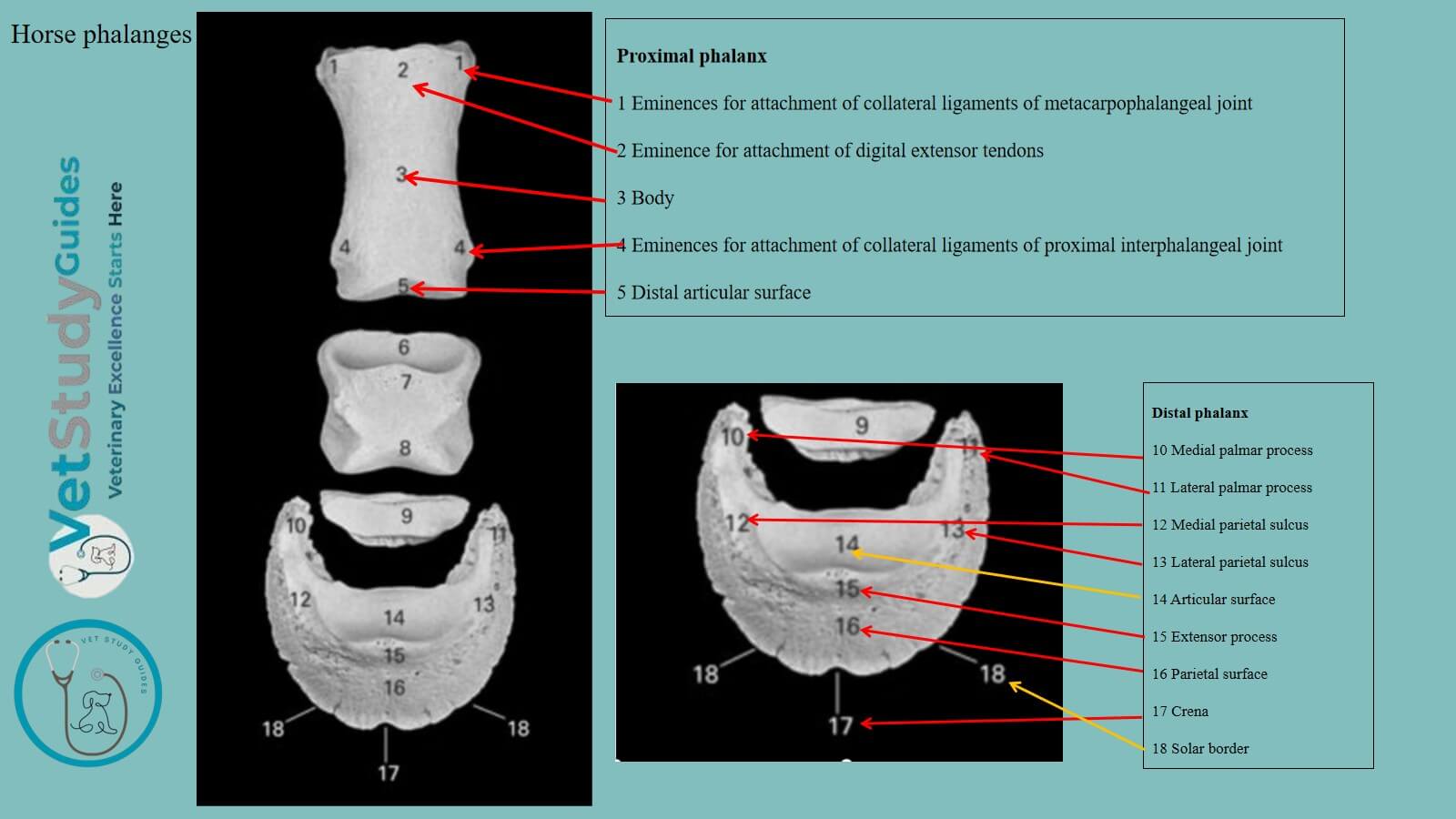
Both the forelimb and hindlimb of a horse skeleton consist of three phalanges in their digits. Here, in this guide, you will learn the details of the horse’s phalanges and digits.
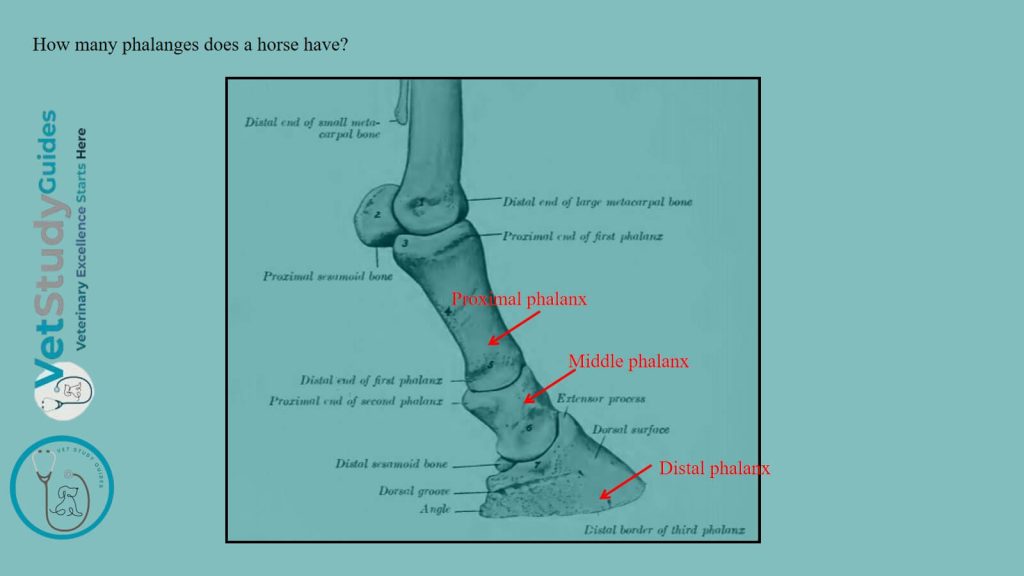
How many phalanges does a horse have?
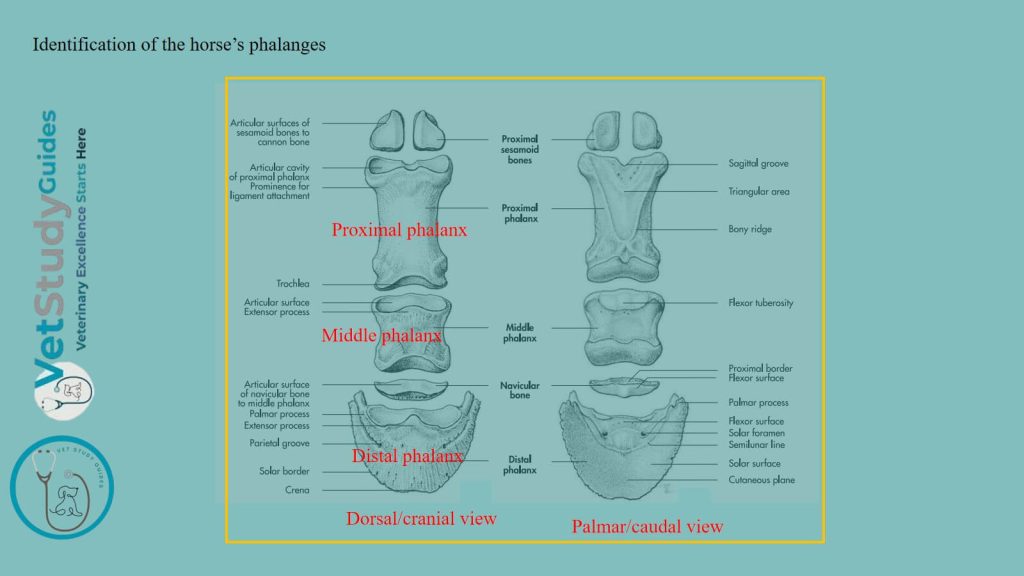
The horse has three phalanges in every limb. Here, the three phalanges are –
- Proximal/first phalanx,
- Middle/second phalanx, and
- Distal and third phalanx.
Every three phalanges form a digit in each limb of a horse.
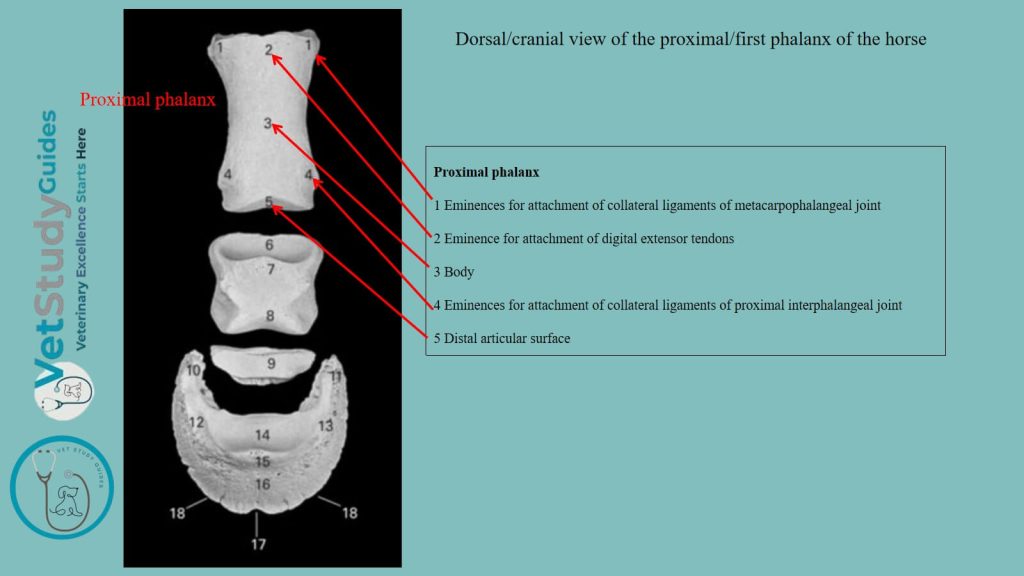
First phalanx of a horse
Type of bone and location: The horse’s first phalanx is a long type of bone. It is situated between the large metacarpal bone and the second phalanx.
Direction and description: This phalanx is directed obliquely downward and forward. It forms an angle of 50 to 55 degrees with the horizontal plane in well-formed limbs. For description purposes, it consists of a shaft and two extremities like a long bone.
Shaft of the first phalanx
The shaft/corpus is wider and much thicker above than below. It presents two surfaces and two borders.
Dorsal surface: The dorsal surface is convex from side to side and smooth.
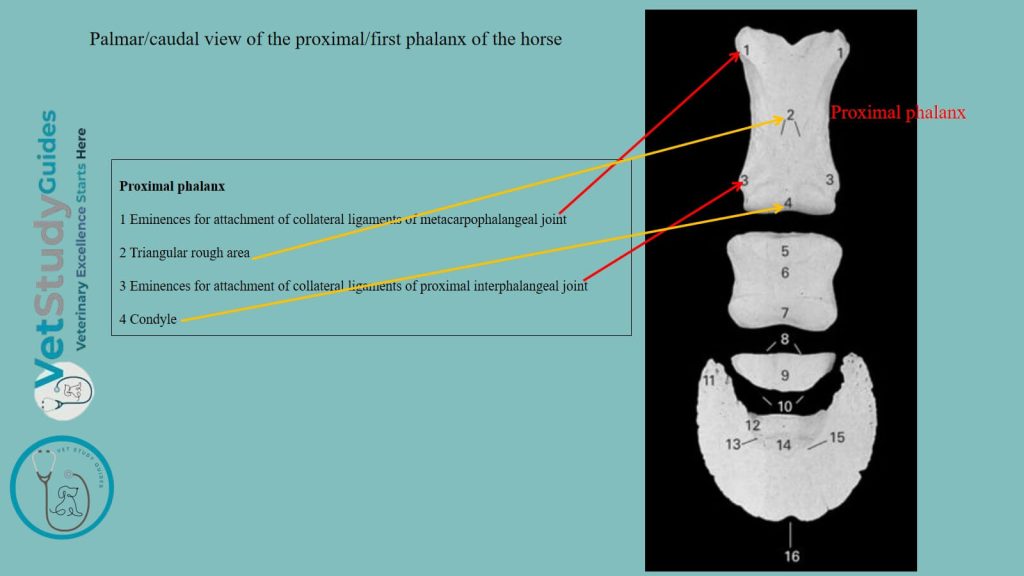
Volar/medial surface: The volar surface is flattened and bears a triangular rough area. It is bounded by ridges which begin at the proximal tuberosities and converge distally. This area furnishes attachment to the distal sesamoidean ligaments.
Borders: The borders, medial and lateral, are rounded and have a rough area or a tubercle on their middle parts.
Proximal extremity of the horse’s first phalanx
The proximal extremity is relatively large. It bears an articular surface adapted to the distal end of the large metacarpal bone.
However, it consists of two glenoid cavities separated by a sagittal groove. Here, the medial cavity is a little larger than the lateral one.
On each side is a buttress-like tuberosity for ligamentous attachment.
The dorsal surface has a slight elevation for the attachment of the extensor tendons.
Distal extremity of the first phalanx
The distal extremity is smaller, especially in its dorso-volar diameter. It presents a trochlea for articulation with the second phalanx.
Condyles: Again, it consists of a shallow sagittal groove separating the two condyles. Here, the medial condyle is a little larger, and the two are separated posteriorly by a notch.
Tubercle: On either side, just above the margin of the articular surface, is a depression surrounded by a tubercle. Within these tubercles, the collateral ligament is attached.
Behind the tubercle is a distinct mark to which the superficial flexor tendon is attached.
Second phalanx of the horse
Location and direction: The horse’s second phalanx is situated between the first and third phalanges. They are directed vertically as the first phalanx.
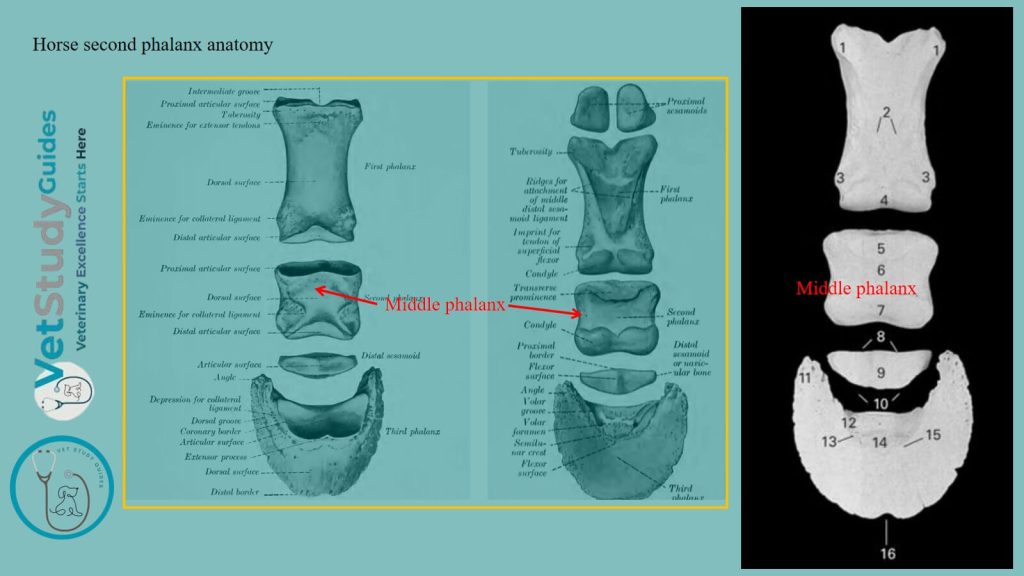
Description: The second phalanx of a horse is flattened from before backward. Its width is greater than its height. However, it may be described as possessing four surfaces.
Proximal surface: The proximal surface presents two glenoid cavities separated by a low ridge. It articulates with the first phalanx.
The middle of the dorsal border is elevated and roughened in front for the attachment of the common extensor tendon. The volar border is thick and overhanging.
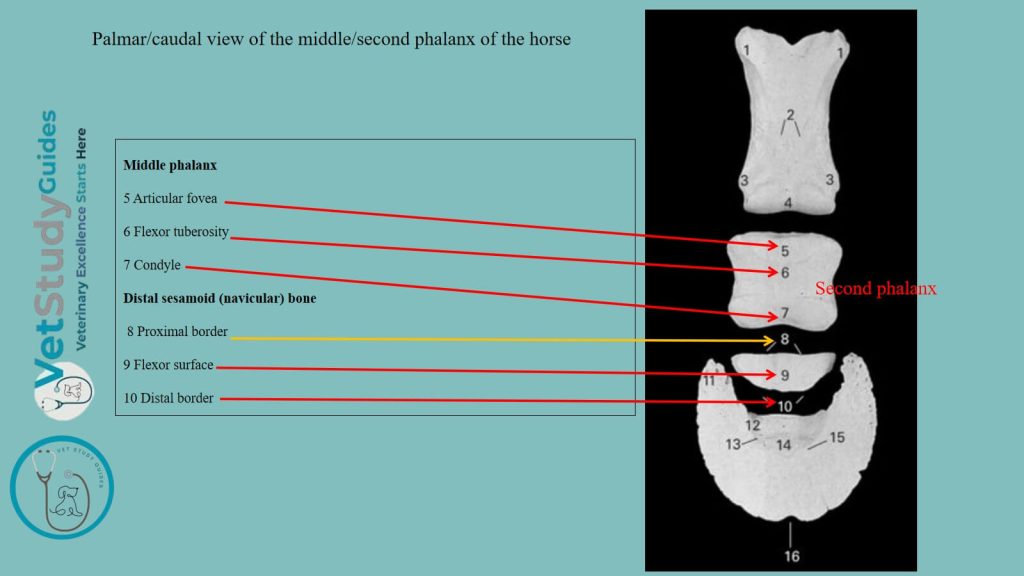
In the fresh state, its middle part is covered with cartilage, over which the deep flexor tendon passes.
On either side, there is an eminence to which the collateral ligament and the superficial flexor tendon are attached.
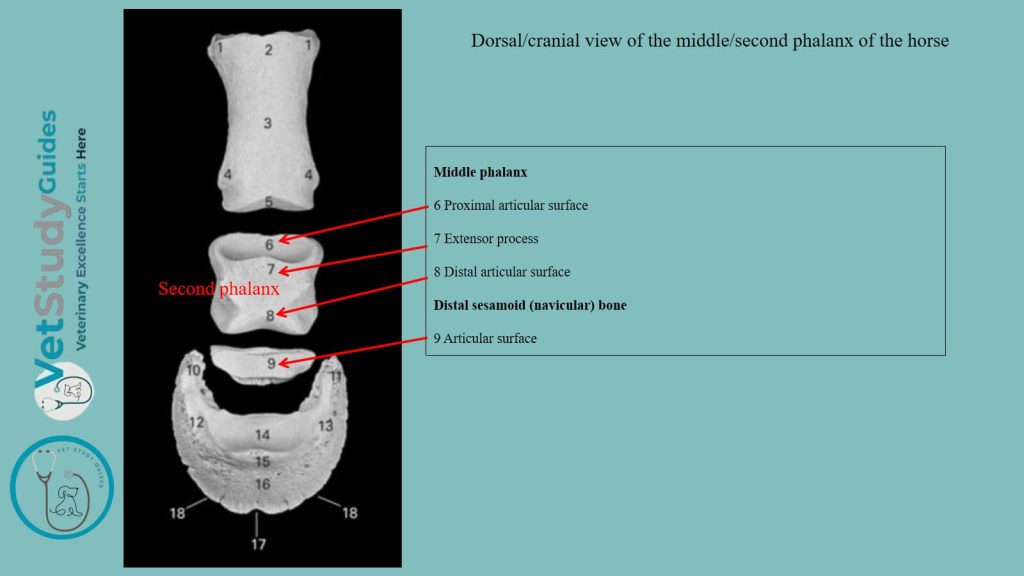
Distal surface: The distal surface is trochlear and articulates with the third phalanx and distal sesamoid bone. It somewhat resembles the trochlea of the first phalanx. However, it is more extensive and encroaches more on the dorsal and volar surfaces.
Dorsal surface: The dorsal surface is convex from side to side and smooth in its middle. On each side of its distal part is a rough depression, surmounted by a tuberosity, to both of which ligaments are attached.
Volar surface: The volar surface is smooth and flattened. The borders which separate the dorsal and volar surfaces are concave from above downward, rounded from before backward.
Third Phalanx of the horse
The third phalanx is entirely enclosed by the hoof to which it conforms in a general way. It presents for examination three surfaces, three borders, and two angles.
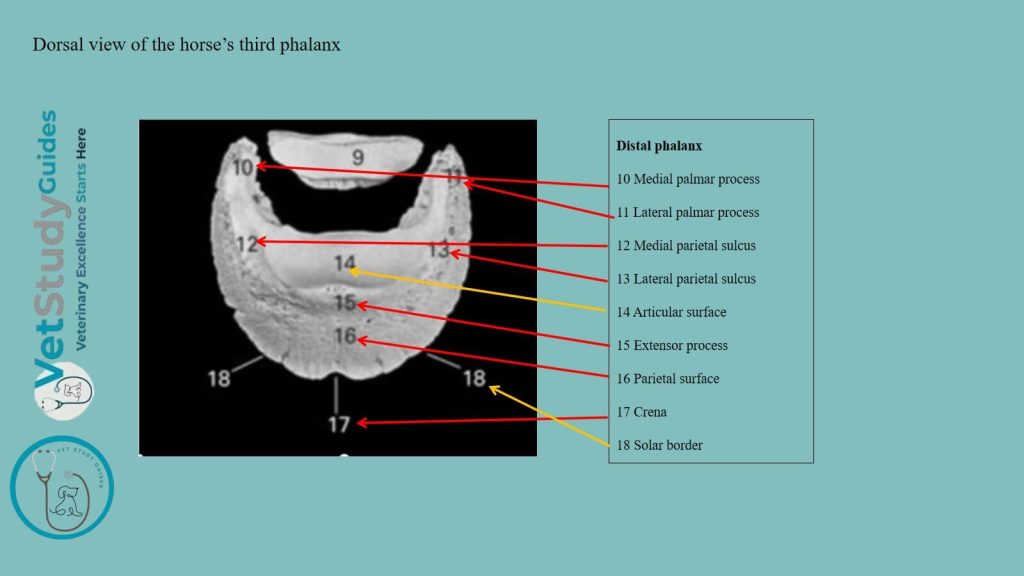
Articular surface of the horse’s third phalanx
The articular surface faces upward and backward. It is chiefly adapted to the distal surface of the second phalanx.
However, a narrow, flattened area along the volar border articulates with the distal sesamoid.
The proximal or coronary border bears a central eminence, the extensor process. Within this, the common extensor tendon is attached.
On either side is a depression for the attachment of the collateral ligament.
Dorsal/ wall surface of the horse’s third phalanx
The dorsal or wall surface slopes downward and forward. The angle of inclination on the ground plane is about 45 to 50 degrees in front.
Laterally, the height diminishes, and the slope becomes steeper, especially on the medial side. From side to side, the curvature is almost semicircular.
The surface is rough and porous, resembling pumice stone somewhat. Numerous foramina of various sizes perforate it.
On either side, the dorsal groove passes forward from the angle and ends at one of the larger foramina. In the fresh state, the dorsal surface is covered by the corium of the wall of the hoof.
The distal border is thin, sharp, and irregularly notched; there is commonly a wider notch in front.
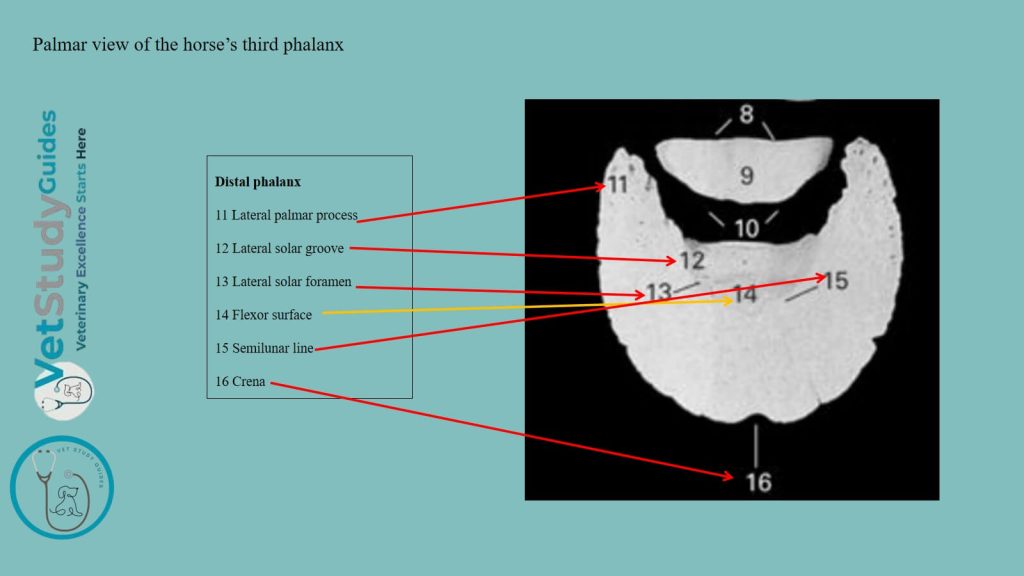
Volar surface of the third phalanx
The volar surface is arched and divided into two unequal parts by a curved rough line, the semilunar crest. The larger area in front of the crest is crescent-shaped, concave, and comparatively smooth. It corresponds to the sole of the hoof and may be termed the sole surface.
The part behind the crest is much smaller and is semilunar. It is related to the deep flexor tendon and is hence called the flexor surface.
However, it presents a central prominent rough area, on either side of which is the volar foramen. Within this foramen, the volar groove conducts from the angle.
The foramina lead into the semilunar canal within the bone. A small canals lead to some of the foramina of the dorsal surface.
The deep flexor tendon is inserted into the semilunar crest and the central rough area behind it.
Angles of the horse’s third phalanx
The angles or wings are prismatic masses which project backward on either side. Here, the medial one is usually the shorter.
Each angle is divided into upper and lower parts by a notch. However, sometimes it is perforated by a foramen which leads to the dorsal groove.
Proximal border and cartilage: The proximal border carries the cartilage. The cartilages of the third phalanx are rhomboid curved plates which surmount the angles on either side.
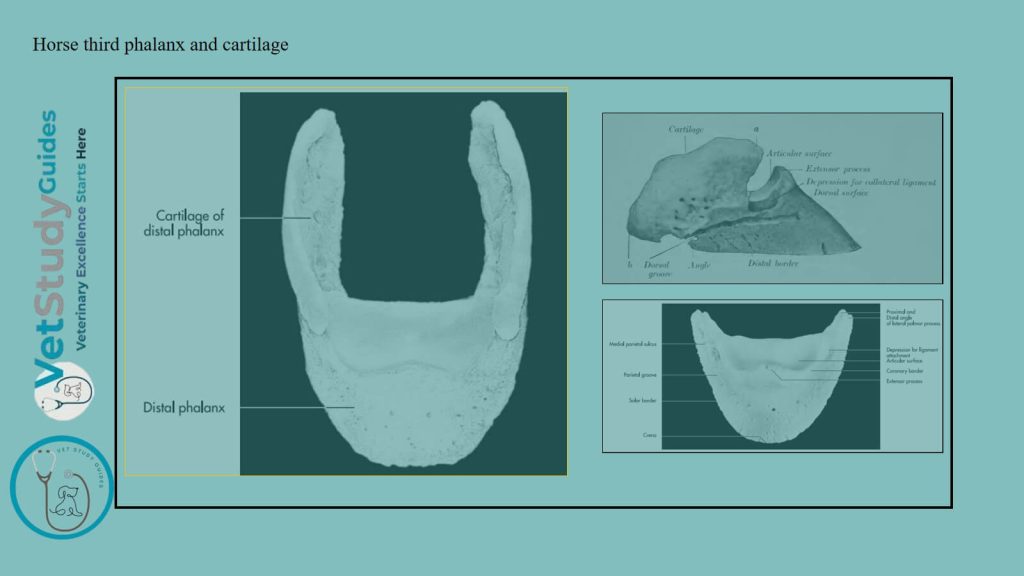
They are relatively large and extend above the margin of the hoof sufficiently to be distinctly palpable.
Abaxial surface: The abaxial surface is convex, whereas the axial is concave. The proximal border is sinuous and thin. However, the distal is thicker and is in part attached to the wing.
Anterior and posterior ends: The anterior end is attached by ligament to the side of the second phalanx. The posterior end curves toward its fellow at the heel. Again, it is perforated by numerous foramina for the passage of veins.
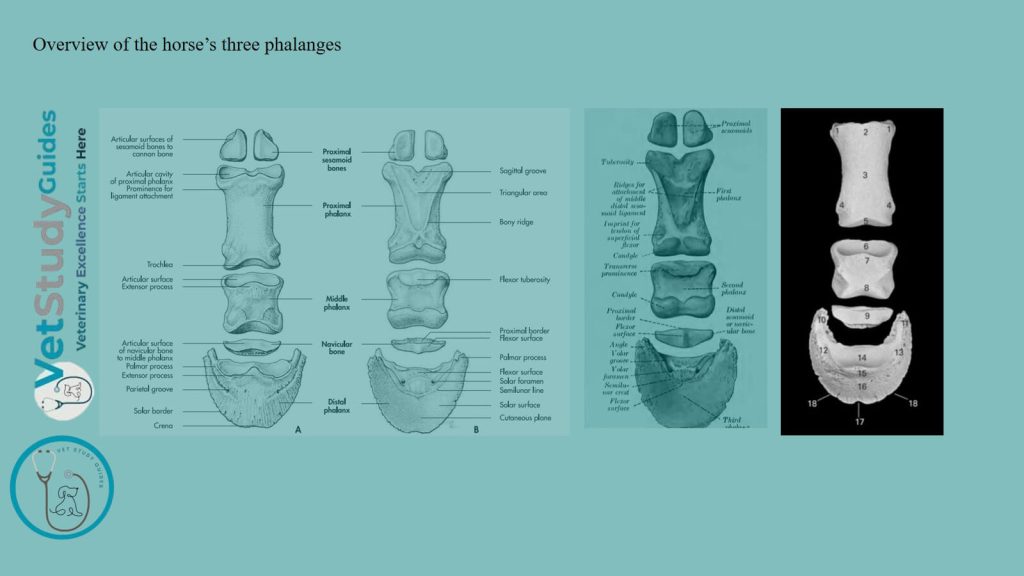
FAQ on horse phalanges anatomy
The first phalanx contains a small medullary cavity in the middle of the shaft. It may be remarked that the bone is twisted slightly when placed volar surface down on the table.
However, it touches the latter by three points only: the proximal tuberosities and the medial condyle.
The horse’s first phalanx ossifies from three centers. The distal end unites with the shaft before birth, and the proximal end at about one year of age.
Again, the second phalanx ossifies like the first, but the proximal end unites with the shaft two or three months earlier.
The third phalanx of a horse presents the peculiar features in ossification /development. While the proximal articular part is still cartilaginous, a perichondrial cap of bone is formed in relation to the hoof. Later, the process extends into the upper part.
The horse has 4 digits, one for each limb. Here, the first, second, and third phalanges form the one developed digit in the horse’s limbs.
During the development of the phalanx, the greater part of the cartilage is ossified. This is a condition commonly termed sidebone. In the young horse, it is the hyaline cartilage, but later it changes to the fibrous type.
Conclusion
So, the horse phalanges are different and possess unique osteological features. Here, the first phalanx of a horse is a long bone, the second one is flattened, and the third one is a triangular wedge that is enclosed by the hoof.
References
- Sisson, S., Anatomy of the domestic animals. W B Saunders Company, USA.
- Dyce and Wensing, Textbook of Veterinary Anatomy, 4th edition, Saunders, USA.
- Duncan, J.S., Singer, E.R., Devaney, J. et al. Radiographic anatomy of the normal ovine digit. Vet Res Commun 37, 51–57 (2013).
- de Alcântara Leite dos Reis, D., Gouveia, B.L.R., Júnior, J.C.R. et al. Comparative evaluation of anatomical details of thoracic limb bones of a horse to those of models produced via scanning and 3D printing. 3D Print Med 5, 13 (2019). https://doi.org/10.1186/s41205-019-0050-2
- Anna Dee Fails and Christianne Magee, Anatomy and physiology of the Farm Animals, 111 River Street, Hoboken, NJ 07030, USA.
- Hilary M. Clayton, Peter F. Flood, Diana S. Rosenstein, and David Mandeville, Clinical Anatomy of the Horse, First edition 2005, ISBN 07234 3302 X.
- Gündemir, O., Szara, T., Pazvant, G., Erdikmen, D. O., Duro, S., & Perez, W. (2021). Radiographic Analysis of the Thoracic Limb Phalanges in Arabian Horses and Thoroughbred Horses. Animals, 11(8), 2205.
- Pasquini and Spurgeon, Anatomy of domestic animals, systemic and regional approaches.
- Solounias, N., Danowitz, M., Stachtiaris, E., Khurana, A., Araim, M., Sayegh, M., & Natale, J. (2018). Evolutionary anatomy of the horse’s manus. Royal Society Open Science, 5(1), 171782.
- Victoria Aspinall B, and Melanie Cappello, Introduction to Veterinary Anatomy and Physiology Textbook, ISBN 978-0-7020-5735-9, Elsevier.
