
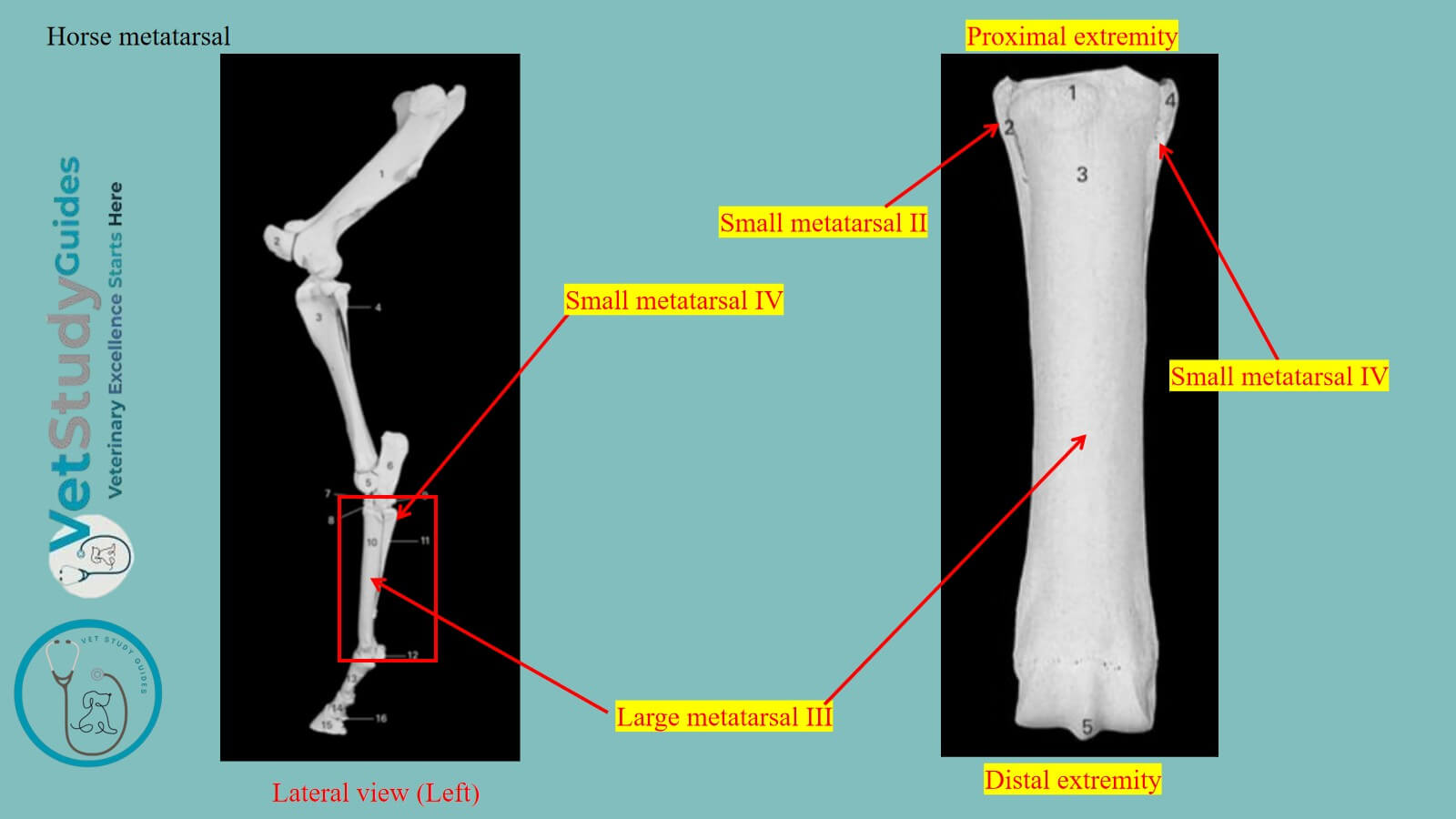
Horse metatarsal bones are the long or modified long bones of its skeleton. They contribute to form the pes segment of the horse’s hind limb and consist of two types of metatarsals.
Here, I will describe the osteological features of the horse’s small and large metatarsal bones with diagrams.
What are the metatarsal bones in a horse?
Bones of the hind limb: Metatarsal bones are hollow, cylindrical bones found in the hind limb of the horse. They are the weight-bearing bones of the limb and act as levers.
Long bone: However, the horse’s large metatarsals are called the long bones, which have a body and two expanded extremities. Again, the shaft or body consists of a compact-bone tube with a medullary cavity.

Modified long bone: On the other hand, the smaller metatarsals of the horse are modified long bones. They are attached to the lateral and medial aspects of the larger metacarpal bone.
Where are the metatarsal bones located?
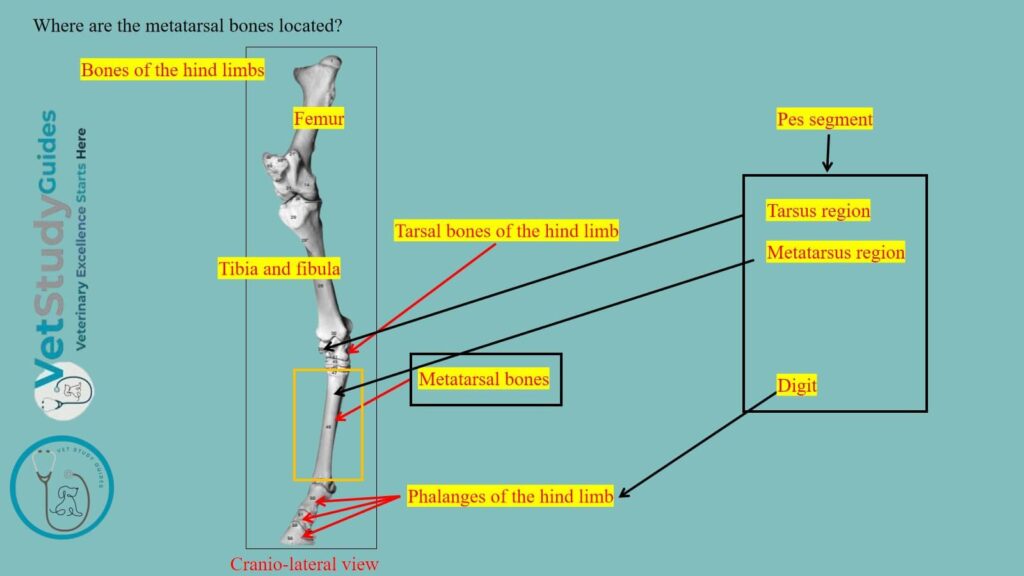
Location: Figure shows the location of the metatarsal bones in the horse’s hind limb. It is located between the hock and fetlock joints.
However, you may also express the location according to the bones and segments of the horse’s hind limb. So, the metatarsals are located below the horse’s tarsal bones and above the first phalanx.
However, the metatarsals (large and small) form the metatarsus part of the pes segment of the horse’s hind limb.
How many metatarsal bones do horses have?
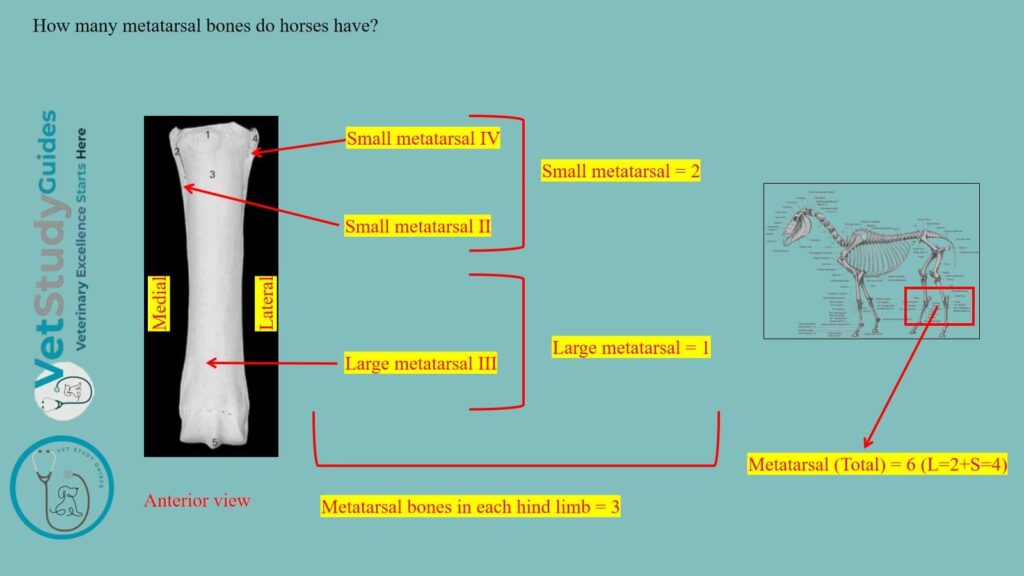
Number of the metatarsal bones: The figure shows the number of the metatarsal bones in the horse’s hind limb. It shows that there are a total of three metatarsal bones in each hind limb of a horse.
Thus, there are two types of metatarsal bones in the hind limb –
Larger metatarsal bone: It is the only one and the largest. This bone is located in the middle of the pes and is considered the third metatarsal.
Smaller metatarsal bones: They are two in number and located on the corresponding aspects of the large metatarsal bone (III). They are expressed as the small metatarsals II and IV.
Thus, the small metatarsal II remains at the medial aspect of the large metatarsal III. Whereas the small metatarsal IV remains at the lateral aspect of the large metatarsal III.
So, the number of the metatarsal bones/ossa metatarsalia has the same general arrangement as the horse’s metacarpal bones. However, they present some important differences compared to those of the metacarpal bones.
Horse metatarsal bones anatomy
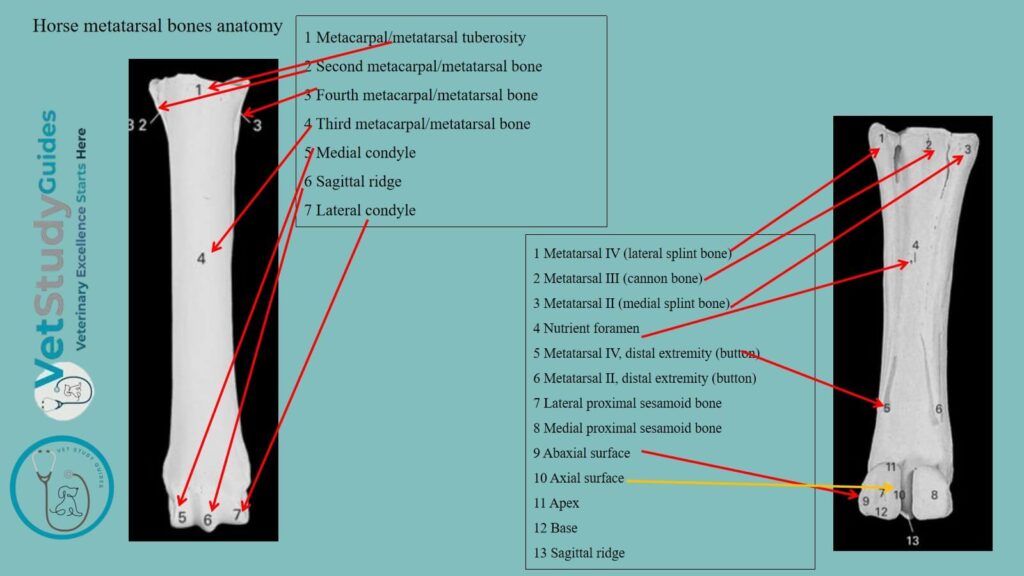
To describe the metatarsals, you might always follow the description of the typical long bones, like a horse’s femur or humerus bones. Thus, you need to describe the following for the horse’s metatarsal bones:
- Body of the large metatarsal: It is hollow, cylindrical, and presents two surfaces – anterior and posterior.
- Extremities of the large metatarsal: There are two extremities in the horse’s large metatarsal bone – proximal and distal extremities.
Equine large metatarsal bone
Here, I will describe the features of the horse’s large metatarsal bones with diagrams. However, you might have the basic knowledge of the description of the horse’s metacarpal bone. This might help you compare the features between the horse’s metacarpal and metatarsal.
The body of the horse’s large metatarsal
Direction and length: The direction of the body of the horse’s large metatarsal is slightly oblique, downward, and a little forward. Here, the third or large metatarsal bone/os metatarsal tertium is about one-sixth longer than the corresponding metacarpal.
However, in a medium-sized horse, the difference between the metatarsals and metacarpals is about 2 inches.

Cylindrical shaft: The shaft is more cylindrical and is almost circular in cross-section, except in its distal part. However, it is a massive bone compared to the ruminant’s metatarsal bone.
Anterior surface: The anterior surface of the horse’s metatarsal bone is rounded.
Groove: At the proximal part of its lateral surface, there is a groove. This groove is directed obliquely downward and backward.
However, it is continued by the furrow formed by the apposition of the fourth or lateral metatarsal bone. It actually indicates the course of the great metatarsal artery.
Shallow impression: A shallow impression in a similar place on the medial side marks the position of the corresponding vein.
Nutrient foramen: The nutrient foramen is relatively higher than on the metacarpal bone.
Posterior surface and facets: Posteriorly, there are two pairs of facets for articulation with the small metatarsal bones. The front is crossed by a rough ridge for insertion, which becomes larger and turns downward on the lateral side behind the vascular groove.
Proximal extremity of the horse’s metatarsal
The proximal extremity/end of the horse metatarsal is much wider from before backward than that of the metacarpal bone. This extremity presents the articular surfaces where the tarsal of the distal row attaches.
Articular surface: Its articular surface is slightly concave and is marked by a large central non-articular depression. It is continued outward by a deep notch.

Articulation: The greater part of the surface articulates with the third tarsal. However, there is a lateral facet for the fourth, and usually a small facet postero-medially for the second tarsal bone.
Metatarsal tuberosity: The anterior-medial aspect of the proximal extremity of the horse’s metatarsal presents the tuberosity. This is called the metatarsal tuberosity, just like the metacarpal tuberosity of the metacarpal bone.
However, the metatarsal tuberosity is more prominent here than that of the ox or ruminant’s metatarsal.
The distal extremity of the equine’s large metatarsal
The distal extremity of the equine metatarsal closely resembles that of the corresponding metacarpal bone. However, it also resembles the one condyle of the distal extremity of the ruminant metatarsal bone.
Thus, you will not find any intercondylar cleft in the horse metatarsals.

Facets for sesamoids: The posterior aspect of the distal end (just above the condyle) presents two facets or depressions. They provide the accommodation to the concave sesamoid bones of the proximal row.
Horse’s small metatarsal bones
Length: The horse’s small metatarsal bones/ossa metatarsalia secundum et quartum are a little longer than the corresponding metacarpals.
Special name: These two metatarsals of the horse (small metatarsal II and IV) are also known as the splint bones.
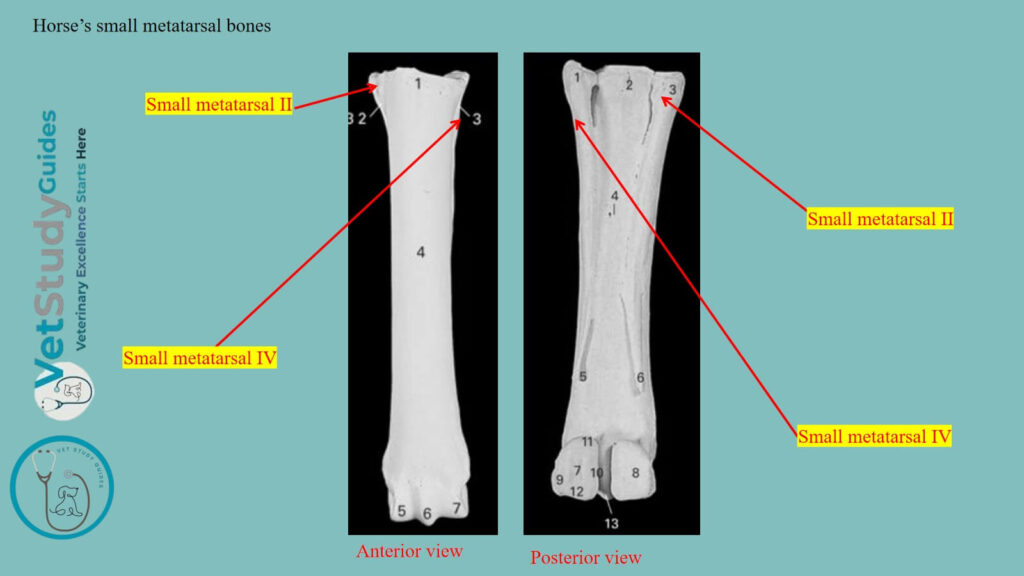
Lateral small metatarsal IV
The lateral (fourth) metatarsal bone (IV) is relatively massive, especially in its upper part. The head is large and outstanding, and bears one or two facets above the fourth tarsal.
However, it also bears two facets, one anterior and one medial, for articulation with the large metatarsal; elsewhere, it is roughened for attachment.
Medial or second small metatarsal II
The horse’s medial (second) metatarsal bone is much more slender than the lateral one. Especially, you will find a slender appearance in its proximal part.
The head bears two facets above for the first and second tarsals, and sometimes one for the third tarsal.
FAQ’s on the horse’s metatarsal bones
In some cases, the distal part of the shaft is slightly bent backward. The distal articular surface extends a little higher behind than in the case of the metacarpal bone.
The large metatarsal bone is even more strongly constructed than the metacarpal. The shell of compact substance is very thick in the middle of the shaft, especially in front and medially.
Well, the horse’s large metatarsal is comparatively longer than the large metacarpal bone. However, the proximal extremity of the large metatarsal is wider than the horse’s large metacarpal.
Again, the articular surface on the proximal ends shows a distinct variable appearance between the metacarpal and metatarsal.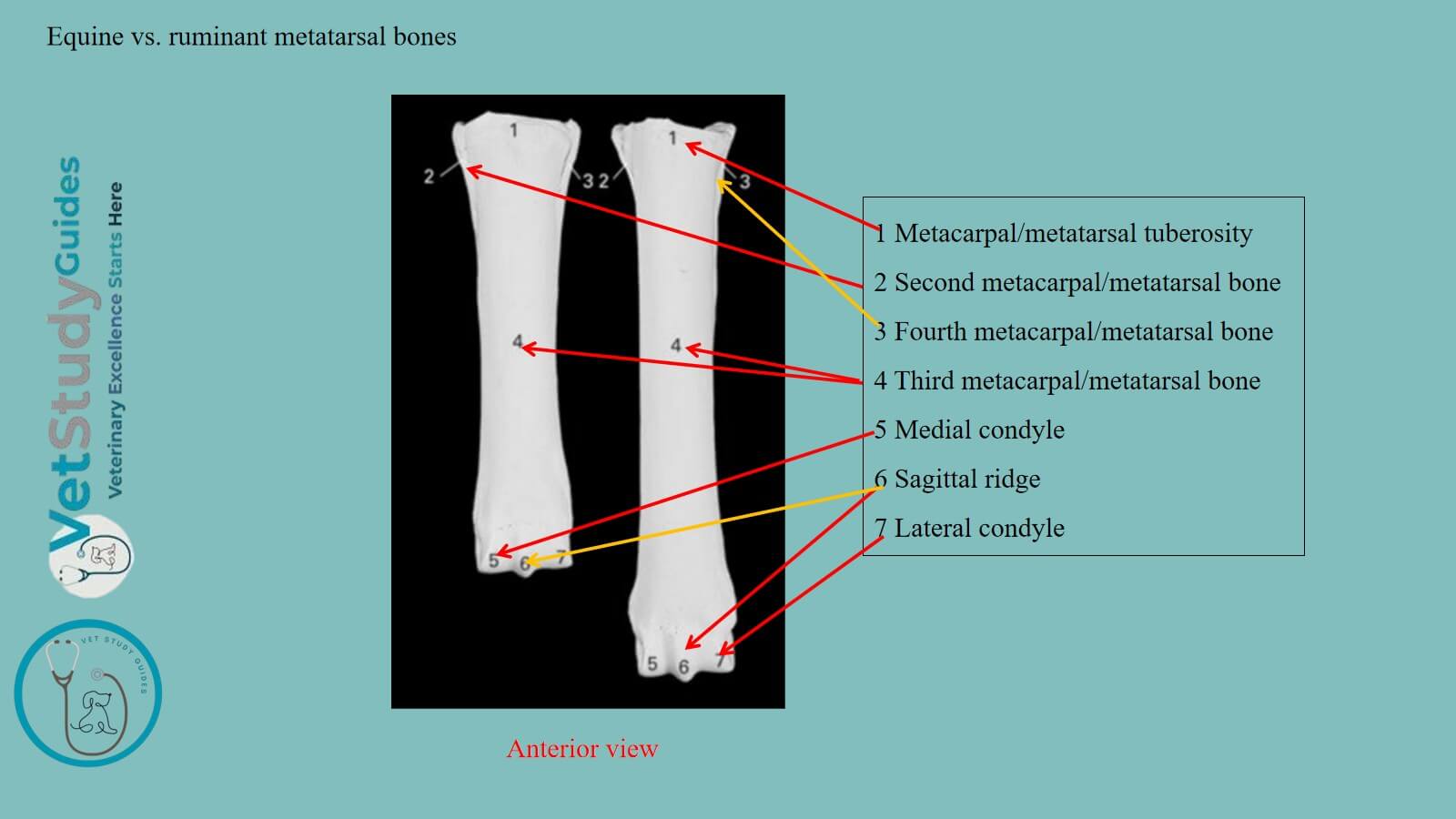
Conclusion
So, the horse metatarsal bones are of two types: large and small. Here, the large metatarsal is number III, and the small metatarsals are numbers II and IV.
Both the large and small metatarsals of the horse form the metatarsus part of the pes of its hind limb.
References
- Sisson, S., Anatomy of the domestic animals. W B Saunders Company, USA.
- Dyce and Wensing, Textbook of Veterinary Anatomy, 4th edition, Saunders, USA.
- Beth Vanhorn and Robert W. Clark, Veterinary Assisting: Fundamentals & Applications, ISBN-13: 978-1-4354-5387-6, Maxwell Drive, Clifton Park, NY 12065-2919 USA.
- Anna Dee Fails and Christianne Magee, Anatomy and physiology of the Farm Animals, 111 River Street, Hoboken, NJ 07030, USA.
- Solounias, N., et al., (2018). Evolution and anatomy of the horse manus. Roy. Soc. Op. Sci., 5(1), 171782.
- Hilary M. Clayton, Peter F. Flood, Diana S. Rosenstein, and David Mandeville, Clinical Anatomy of the Horse, First edition 2005, ISBN 07234 3302 X.
- Pasquini and Spurgeon, Anatomy of domestic animals, systemic and regional approaches.
- Alcântara, et al. Comparative anatomy of the thoracic limb bones of a horse via scanning and 3D printing. 3D Print Med 5, 13 (2019).
- Victoria Aspinall B, and Melanie Cappello, Introduction to Veterinary Anatomy and Physiology Textbook, ISBN 978-0-7020-5735-9, Elsevier.
- Piličiauskienė, G., et. al., (2022). Horses in Lithuania in the Late Roman-Medieval Period (3rd-14th C AD) Burial Sites. Animals, 12(12), 1549.
Reviewed and Edited by